When everyone has the tools, what makes your thinking and craft yours?
Here's what we're sensing in creative businesses right now.
AI has made it dramatically easier to produce creative work. Quickly. Cheaply. Sometimes brilliantly. Sometimes not.
For a while, the easiest problem to talk about was AI slop. Bad work is reassuringly easy to recognise. The more interesting problem is the work that isn't bad at all.
It's strategically sound. On-brief. Well executed. Hard to fault. And quietly interchangeable with whatever a competitor's tool has just produced too.
That's the shift. Avoiding slop is the easy part. Avoiding sameness is harder, and it's about to matter more, not less.
The same tools are increasingly available to everyone. The same research surfaces in seconds. The same category conventions can be analysed in minutes. The same fifteen strategic territories can appear before lunch, whether they're being built by an agency in Shoreditch, a consultancy in New York or an in-house team in Manchester.
Capability and access are spreading extraordinarily quickly. Distinctiveness isn't.
We saw the signal clearly in the Ingenuity+ CMO Leadership Pulse this summer. Across predictive analytics, reporting, optimisation, targeting and personalisation, more than 80% of marketing leaders expect agencies to be capable now, not in five years. AI capability is becoming baseline.
But underneath those numbers was the more interesting clue. When leaders were asked where AI was actually improving performance, better insight and better decision-making came ahead of speed and efficiency.
That takes us somewhere much more useful than another debate about whether AI is good or bad for creativity. If access is democratised, the advantage moves. From generating more possibilities to knowing what deserves to survive. From recognising the pattern to knowing when to break it. From capability to judgement.
SEE. SHAPE. SCALE.
Earlier this summer, while looking at the next creative advantage, we kept coming back to three simple words. They still hold because they compress a much bigger shift into something a creative business can actually use.
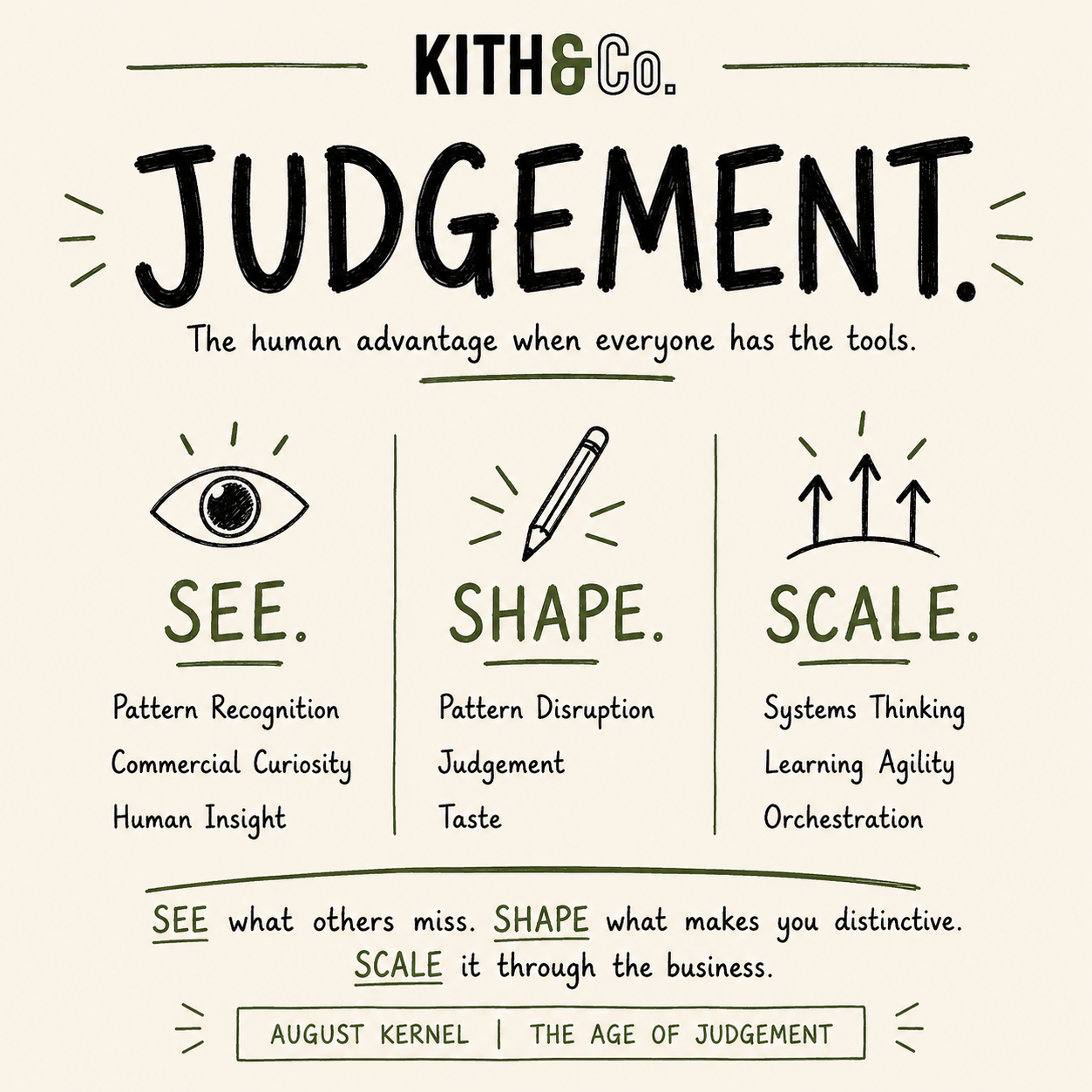
AI can strengthen all three. It cannot decide what your business should stand for.
SEE what others miss. SHAPE a point of view rather than simply reproduce the pattern. SCALE it through people, systems and learning.
Judgement is not a seniority perk
Most creative organisations already have judgement. It just tends to live inside particular people.
The founder has it. The ECD has it. The strategist who's been there twelve years has it. The brilliant account lead who knows exactly when to push a stakeholder has it.
The cultural question is: does everybody else get the conditions to develop their own?
We call much of this experience. Sometimes instinct. Occasionally taste. All true. But culturally, those words can hide something important. If the reasoning stays inside the head of the person making the call, nobody else gets better at making it.
For years, producing the work was itself part of the apprenticeship. You researched and hit dead ends. You wrote the rubbish first draft before the good one. You built ten routes and watched nine of them die. You made a call, saw what happened and made the next one slightly better.
AI removes a lot of that friction. Mostly, that's a gift. But some of that friction was quietly doing developmental work nobody had needed to name before now.
So the question isn't whether judgement still matters. It's what we're deliberately putting back now that some of the old routes to developing it are disappearing.
And judgement doesn't develop from being consulted. It develops from consequence. Someone makes the call. Something happens. The room examines why. The next call gets a little better. An opinion that never has to survive contact with a real outcome is commentary, not judgement.
The accidental curriculum has gone quieter
There was another way judgement used to travel, one nobody designed on purpose. You'd overhear a senior person handle a difficult stakeholder call from two desks away. Watch them manage up, then turn around and manage the room completely differently ten minutes later. Nobody taught that deliberately. You absorbed it through proximity and time.
Hybrid work didn't just change where people sit. It quietly weakened a curriculum nobody had ever had to write down because it had never needed to be.
The answer isn't recreating the office of 2006. It's recreating what was valuable about it deliberately: exposure, explanation, context and consequence. Not osmosis. Practice.
Critique is where judgement becomes visible
Judgement and critique aren't the same thing. Judgement is the capability. Critique is one of the places people get to practise it in public.
Good critique doesn't tell people what to think. It lets them hear how someone else is thinking. Why this route feels distinctive. Why that one is beautifully made but could belong to anybody. Why the obvious answer is technically right and still wrong for this business.
That is why the work that gets discarded matters. Not because 'the discard' is the idea, but because explaining the call makes judgement visible. The useful question for a creative business is not whether it critiques. It's whether critique develops more people who can make the next call.
Make judgement part of the business
If judgement is going to be a source of distinction, it can't live only in the creative review. It has to show up across the life of the business.
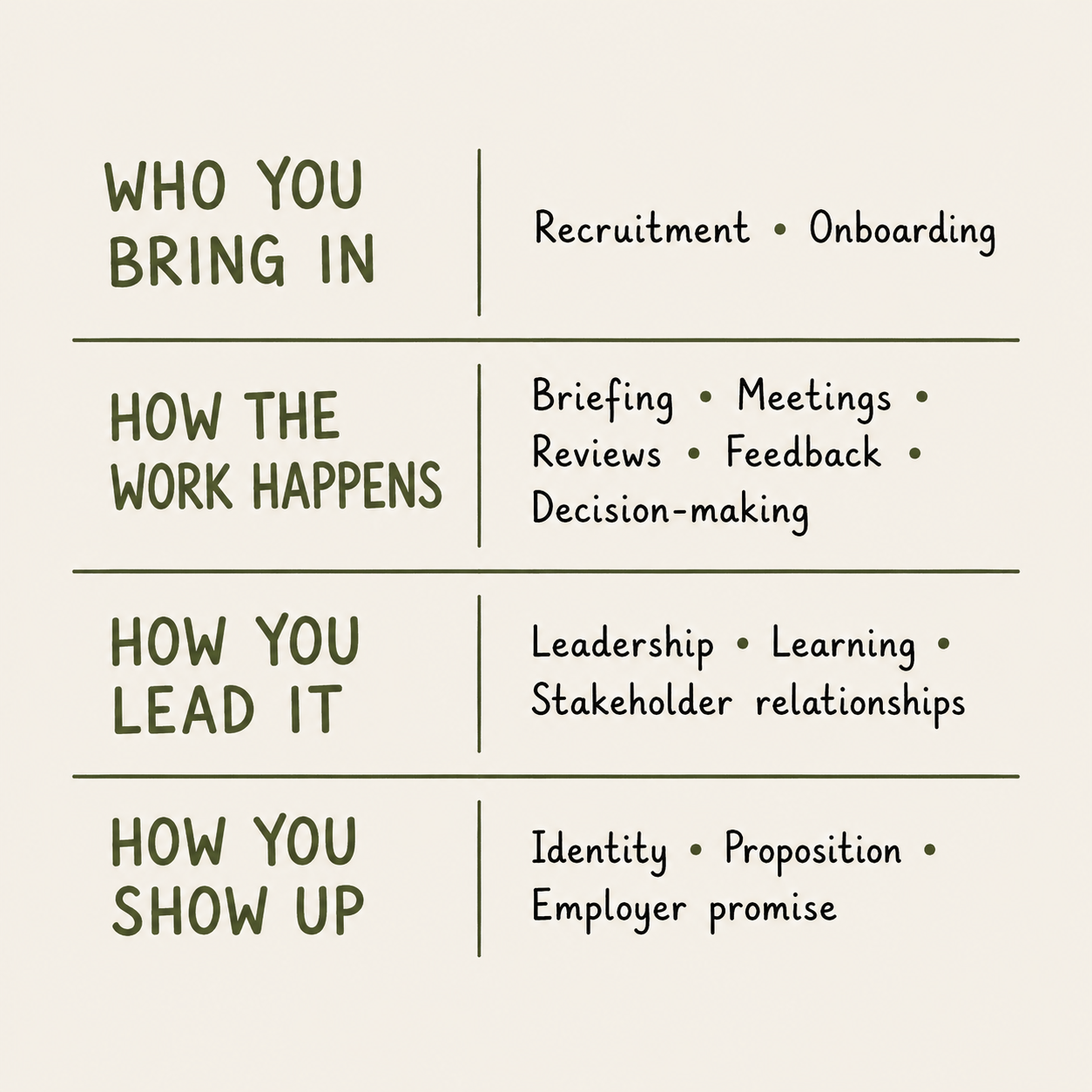
Judgement isn't something you train once. It's something a culture gives people repeated opportunities to practise. The exact interventions will look different in every business. That's the work.
The point is not to publish a twelve-step operating manual. It's to notice whether judgement is part of how the business hires, briefs, reviews, decides, leads, learns and describes itself — or whether it still lives mainly inside a few experienced heads.
Don't codify taste. Create the conditions.
There is an obvious trap here. Codify the founder's taste. Write down the creative director's instincts. Turn one person's judgement into everybody else's rulebook.
Resist it. That's not developing judgement. It's institutionalising yesterday's answer.
The job isn't to hand people your taste. It's to build the conditions in which theirs can develop inside a clear collective vision. Strong identity without sameness. Shared standards without identical thinking. Enough coherence to know what the business stands for, and enough freedom to surprise it.
Who owns distinctiveness?
We joked this summer about the rise of the Chief Distinctiveness Officer. The title is deliberately provocative; the question underneath it isn't. If capability becomes easier to access and distinction becomes harder to protect, who is responsible for keeping a business recognisably itself?
Creative? Strategy? Leadership? People? The answer is all of them. Distinctiveness is not a department. It is what happens when enough people across a business can see, shape and make good calls without waiting for the same senior person to do the thinking for them.
The KITH&Co. POV
Feeling: People feel safe enough to question the obvious answer. Judgement has permission to exist.
Behaviour: Reasoning gets explained. Assumptions get challenged. Judgement becomes visible.
Output: Fewer generic answers. More distinctive decisions. Judgement creates distinction.
Growth: People are given real calls to make, and real room to get some wrong. Experience becomes judgement.
Joy: People develop their own contribution, not just execute someone else's taste. Individual judgement strengthens the collective.
The baton pass
June asked what happens when a business has to protect its identity deliberately. July asked whether authority really travels when the leader leaves the room. August takes both ideas one step further.
Authority without judgement creates anxiety. Judgement without authority creates frustration.
July handed over the decision. August is about building the thinking that makes the decision worth having. The thread is the same: culture becomes stronger when what matters is not trapped in one person's presence.
Vision over velocity
AI has given every creative business more speed. The question is what that speed is for.
Speed has become easier to buy. Vision hasn't. When technology increases a business's velocity without strengthening its judgement, you don't necessarily get a more creative organisation. You may simply get one producing more good-enough work, faster than ever.
So the cultural job isn't keeping pace for the sake of it. It's protecting the conditions for better judgement while everything else accelerates.
AI democratises capability. It doesn't democratise judgement. Judgement isn't transferred. It's developed. Culture determines whether people get the conditions to develop it. Distinctiveness is what happens when enough people do.
Where to start
A Culture Intelligence Audit gives us a way to see where judgement already lives, where it gets stuck, where it is over-dependent on a few people and where the conditions around it need attention.
We don't think the answer is another generic capability programme. The useful work is specific to the business: understanding where judgement already shows up, where it disappears, and what needs to change for more people to develop it.
Creative businesses have always promised some version of: come here to do brilliant work and learn from brilliant people. As AI takes on more of the work people once joined to learn how to do, that promise needs to become more deliberate.
'You'll get faster at using our AI stack' isn't much of an employer proposition. 'You'll become a better thinker here' might be.
That's the opportunity. Not to make everybody think the same way. To create a culture where more people develop the judgement to contribute something genuinely their own.
If this is landing, it's worth exploring together.